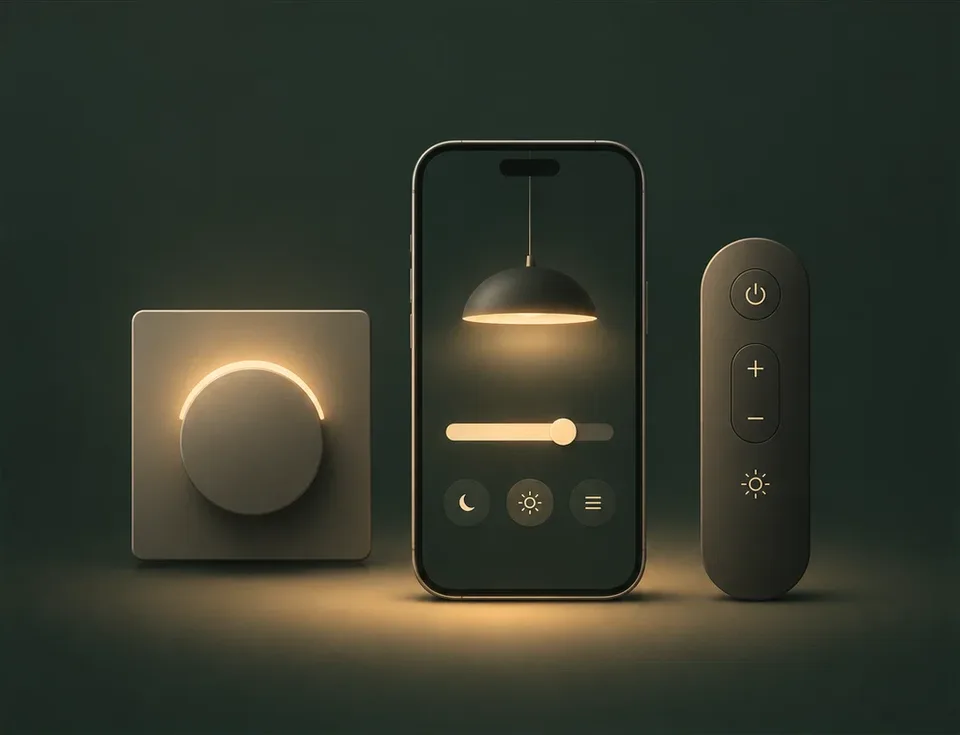
Dimming seems simple from the outside. Turn a knob, press a button or move a slider, and the room changes from bright to soft. Once you've experienced a well-controlled lighting scene, it's easy to want the same thing in every room.
The surprise is that not every LED fixture is dimmable, and not every dimmer works with every dimmable LED.
This is less about finding an expensive control and more about checking the full system.
The light is only one part of the equation
An LED fitting often relies on a driver or other control electronics to supply the appropriate power. Some products are designed for fixed output. Others support specific dimming methods. The control might be phase-cut, 0–10V, DALI or a particular wireless system, depending on the product and application.
Those labels are not interchangeable. A control and driver need to be compatible, and sometimes the minimum load, circuit wiring and number of fittings matter too.
If a product description merely says “LED,” that tells you nothing about dimming capability.
Why a bad match can look strange
An incompatible combination can produce flicker, unexpected shut-off, a narrow dimming range, noise or poor response at low levels. You might find that the lamp drops suddenly from moderately bright to off rather than dimming smoothly.
That doesn't automatically mean the LED fitting is defective. It may mean the specified control method or operating combination is wrong. The right first step is to check the manufacturer's documents for the exact model and driver.
CCT switching is not the same as dimming
Colour temperature and intensity are separate properties. Some fittings offer multiple preset CCT options, some allow continuous tunable-white control, and some only dim. A remote that changes colour is not evidence that the same fixture can be integrated into a particular wall-dimmer system.
When comparing smart lighting, ask exactly what is controlled: brightness, colour temperature, groups, scenes or all of them. Then ask which driver, controller, gateway or remote is required. Select brands may offer these functions, but the options are product-specific.
Plan the controls before the wiring is complete
Dimming can affect the choice of wiring, driver location, switchgear and controls. Some systems require separate control wiring or compatible wireless infrastructure. A room already wired for a basic on/off circuit may not support every desired upgrade without further changes.
This is why control decisions belong in the early lighting conversation, not in the last week of finishing. Have the lighting supplier, designer and qualified electrician agree on the intended system before committing to installation.
What a proper demonstration should show
If dimming is an important reason for choosing a product, ask to see the exact fitting or an approved equivalent with the intended driver and control. Watch it move through its useful range. Does it respond smoothly? Does it stay stable at lower levels? Can it switch off and return to a predictable setting?
For multiple fittings, also consider whether they dim consistently together. A demonstration of one product alone cannot prove the behaviour of an entire mixed installation.
Dimming should solve a problem
The point isn't to add controls for their own sake. A living room may need brighter light for guests and gentler light for a quiet evening. A restaurant may use different scenes across the day. A workplace may need better task control.
Start with those human needs. Then select a technically compatible lighting system to deliver them. A simple reliable on/off arrangement is preferable to an elaborate dimming promise that the actual products cannot support.
One clear question can prevent a complicated mistake
Instead of asking whether a light is “smart,” ask: “Will this exact fixture, with this exact driver, work with this exact control in the way I want?” Write down the answer alongside the product reference. It may sound overly cautious, but the right compatibility check is much easier before installation than after every switch plate is finished.
Good lighting controls are almost invisible in everyday use. They let the room adapt naturally—and they work as expected when someone touches the switch.
Explore the lights: Architectural lighting
Have a lighting requirement? Ask us on WhatsApp.