Bedrooms are strange rooms to light. We ask them to feel restful, then expect them to help us find a black shirt in a dark wardrobe, read comfortably, get ready in front of a mirror and occasionally finish work on a laptop.
It's no surprise that one bright ceiling light can feel like a compromise. The problem usually isn't that the fixture is bad. It's that the room has several jobs and only one lighting response.
Begin at the bedside
The bed is the visual and practical centre of most bedrooms. Start by asking what happens there after dark. Does someone read while another person sleeps? Is there a side table on both sides? Will a wall-mounted lamp be more useful than a hanging pendant?
A bedside light should serve its particular purpose without directing an uncomfortable beam at the person lying next to it. The height, direction and beam depend on the bed, mattress, headboard and fixture. Photographs online rarely tell you enough to choose those dimensions confidently.
Matching lamps are attractive, but matching isn't compulsory. If the two sides of the bed are used differently, independent controls are often more important than a perfectly symmetrical picture.
The wardrobe needs a different kind of light
The bedroom may look pleasantly warm, yet the wardrobe can remain shadowy. Lighting mounted behind someone standing in front of open doors may cast their silhouette across the clothes. Consider the direction of light and the wardrobe's internal arrangement before assuming an overhead fitting is enough.
Linear lighting and LED strips are used in many cabinet details, but their suitability depends on profiles, drivers, mounting surfaces, heat management and access. Any fitting used inside furniture must be selected and installed for that application, not improvised from whatever strip happens to be available.
A dressing mirror brings another question: where does the light fall on the face? A single source directly overhead often makes unflattering shadows. Balanced lighting from appropriate positions is generally more useful than trying to solve everything with more ceiling brightness.
Decide which part of the room should feel quiet
A bedroom doesn't have to be uniformly bright to be functional. Soft ambient light can come from a cove detail, a shaded lamp or appropriately diffused fittings. A more focused source can support reading. Brighter general light can be available for cleaning and getting ready.
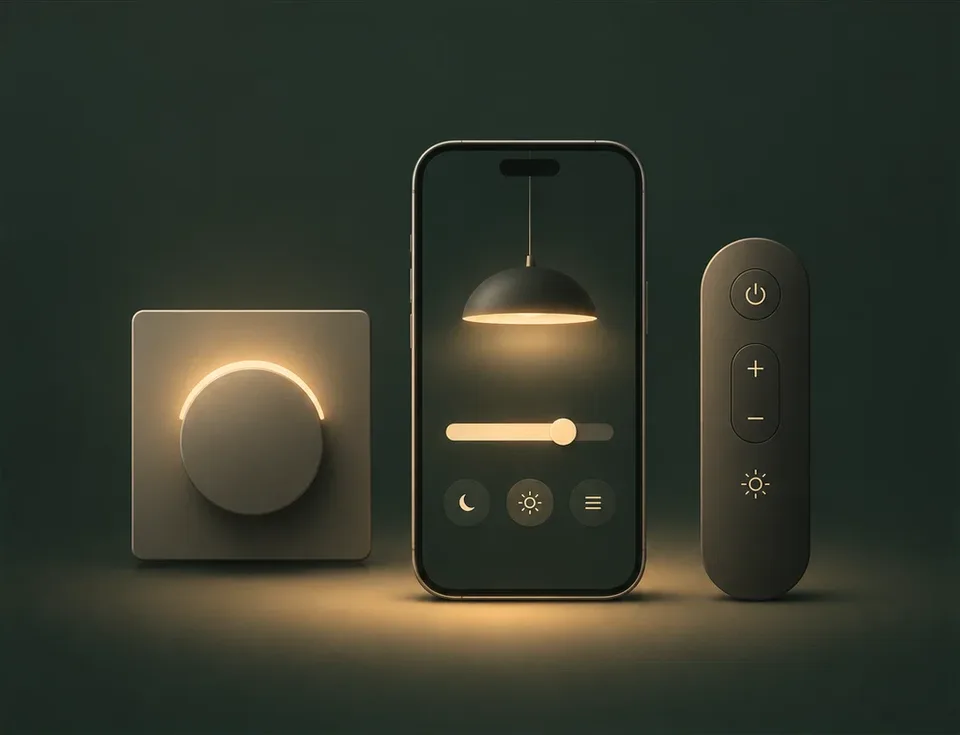
This is where separate switching groups help. You might want the wardrobe light without the rest of the room or a bedside light that can be turned off without walking to the door. Check compatibility before introducing dimming; only specific supported fixtures and drivers will behave properly with a given control.
Why the colour of light isn't the whole story
Warm light often feels welcoming in a bedroom, but a Kelvin number doesn't tell you everything. Two sources with the same labelled colour temperature may differ in colour rendering, glare, beam shape and diffusion. Room finishes matter too. A cool grey wall and a warm wooden wardrobe won't react identically to the same fitting.
More importantly, an exposed bright source in your line of sight can remain uncomfortable even if its colour is warm. Direct light and reflected light feel different. Pay attention to what the eye sees from a lying-down position, not only what the floor looks like when you're standing.
A bedroom-lighting plan you can actually use
First, identify three situations: winding down, getting dressed, and reading or working. Then give each its own adequate lighting. After that, decide what should remain visually calm.
If the bedroom is small, resist the temptation to pack the ceiling with a neat grid of fittings. One effective general layer, a thoughtful bedside solution and proper wardrobe lighting may be more valuable than an impressive count of downlights.
Try the room with the main light switched off
This is a revealing little test. Sit on the bed with only the bedside source on. Is there enough light for the activity it is supposed to support? Can the other person sleep without a bright source in their eyes? Walk to the wardrobe, open its doors and see what changes. Then look at the mirror.
If every useful activity forces the main ceiling light back on, your layers may not be independent enough. The fix might be as small as adding the right bedside source or as involved as changing the wiring scheme. Either way, the problem becomes much clearer when you test ordinary behaviour rather than admire the ceiling.
The best bedroom lighting is rarely the part people notice first. They notice that they can find their clothes, read comfortably and settle down without turning the entire room into a brightly lit stage. That's the difference worth designing for.
Explore the lights: Decorative lighting · Architectural lighting
Have a lighting requirement? Ask us on WhatsApp.