Outdoor lighting has an unusual challenge: the brighter the fitting appears, the less carefully it may be doing its job. A harsh floodlight can make a garden seem visible from a distance while creating deep shadows nearby, uncomfortable glare and unwanted light spilling into neighbouring spaces.
A considered outdoor scheme starts with an opposite question: where is light genuinely needed, and where should darkness remain?
Separate movement from atmosphere
An entrance, a step change and a route to a gate have practical needs. People should be able to identify the path, read changes in level and understand where they're going. A garden tree, stone wall or architectural façade may be illuminated for an entirely different reason: to reveal form and create atmosphere.
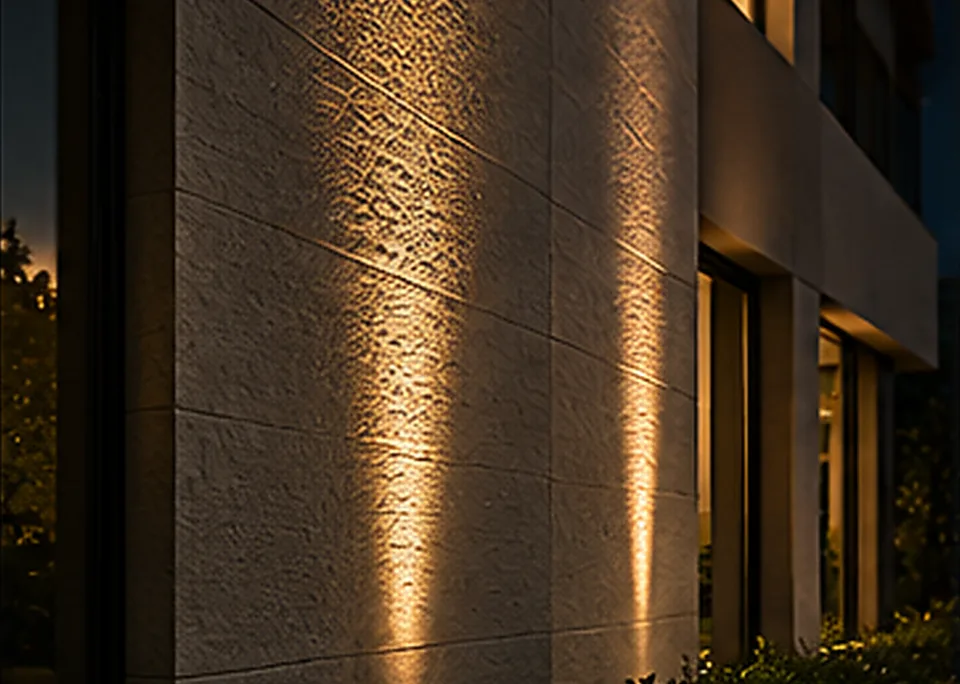
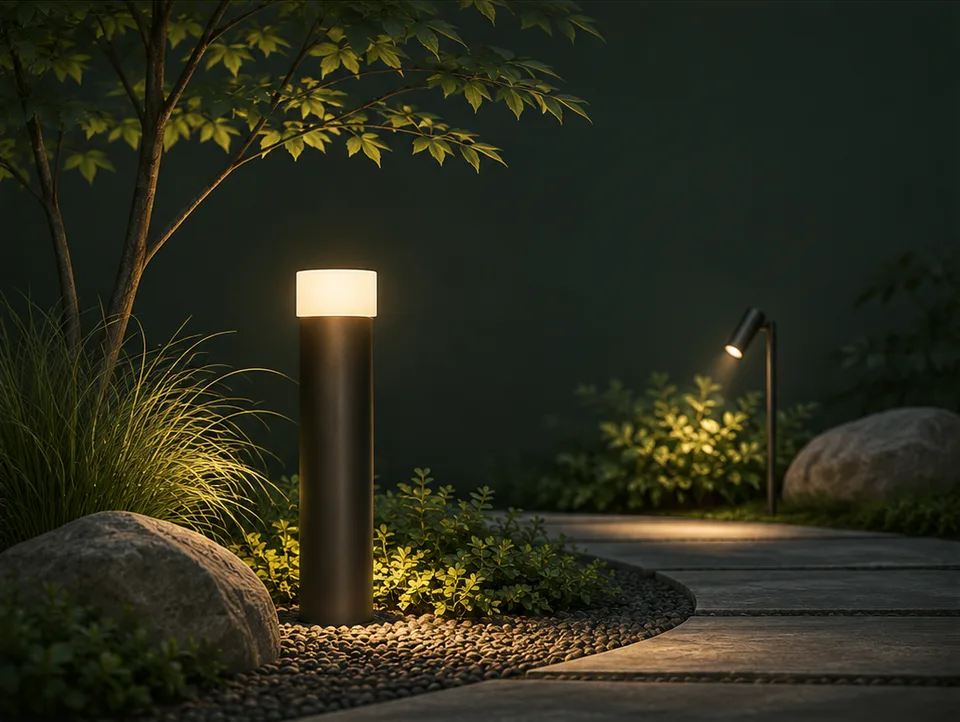
Using the same high-output fixture for both jobs can lead to a blunt result. A pathway light may need controlled distribution close to the ground. A carefully aimed spike light can draw attention to planting. A façade light might emphasise texture rather than illuminate the whole building evenly.
Glare works against useful visibility
Imagine walking towards a bright outdoor fitting. The source is obvious, but what happens to the surfaces around it? Very bright, exposed light can make nearby darker areas harder to read comfortably. Shielding, aiming and sensible output selection often matter more than selecting the most powerful product.
Avoid judging an outdoor scheme only from a photograph taken facing the illuminated wall. Stand where people will actually approach, sit or walk. Check the view from neighbouring windows too.
The dark parts are part of the design
DarkSky International and the Illuminating Engineering Society promote five principles for responsible outdoor lighting: use light only when needed, direct it where needed, use no more than needed, control it and choose its colour thoughtfully.
These principles support both visual quality and restraint. Lighting a façade doesn't mean every elevation must glow until morning. A pathway doesn't need an uninterrupted row of excessively bright sources if a lower-output, properly placed solution is sufficient.
Weather exposure is a specification, not a guess
Outdoor fittings must be suited to their actual environment. Exposure to rain, splashing water, dust, heat, corrosion or accidental contact varies between a sheltered porch and a garden bed.
A product's IP rating describes particular ingress-protection tests, but it is not a blanket guarantee of suitability for every outdoor condition. Installation instructions, material choice, seals, cable entries and maintenance all matter. Use the manufacturer's documentation for the exact product and location, with qualified electrical installation.
Do not assume a decorative wall light is outdoor-rated simply because it looks suitable on a façade.
Plan controls around real use
An entrance light may be needed when someone arrives. A garden accent might only be useful during occupied evening hours. Timers, sensors or suitable control systems can reduce unnecessary lighting, but the correct technology depends on the space, product compatibility and security needs.
Outdoor design should also consider how vegetation grows. A spike light precisely aimed at a young plant may be blocked or visually transformed as the garden matures. Accessible adjustment and maintenance can be part of the plan.
A useful night-time walk-through
When the installation is ready, walk the actual routes after dark. Approach the gate from outside. Use the steps. Sit where guests may sit. Look back towards the house. Check for glare, dark gaps, spilled light and fixtures that call more attention to themselves than the surfaces they illuminate.
Think about the view from indoors
A garden is often experienced through a living-room window. An outdoor fixture that looks attractive from the path might shine directly into the room or appear as a distracting reflection in the glass.
Review the evening view both ways: from outside looking towards the building, and from inside looking into the landscape. A coherent scheme considers both observers rather than treating the exterior as a separate photograph.
A memorable outdoor space is not necessarily the brightest one in the neighbourhood. It is the one that gives you enough light to move confidently, reveals the architecture with restraint and still allows the night to feel like night.
Explore the lights: Outdoor lighting
Have a lighting requirement? Ask us on WhatsApp.