There are interiors where you remember the chandelier immediately. And there are others where you remember the room—the way a stone wall seemed to glow, the soft edge of a ceiling or the depth of a timber surface—without remembering a single visible fitting.
Neither approach is inherently better. But when the architecture itself is meant to be the main subject, lighting can be most compelling when the fixture does not compete for attention.
Light the material, not the catalogue image
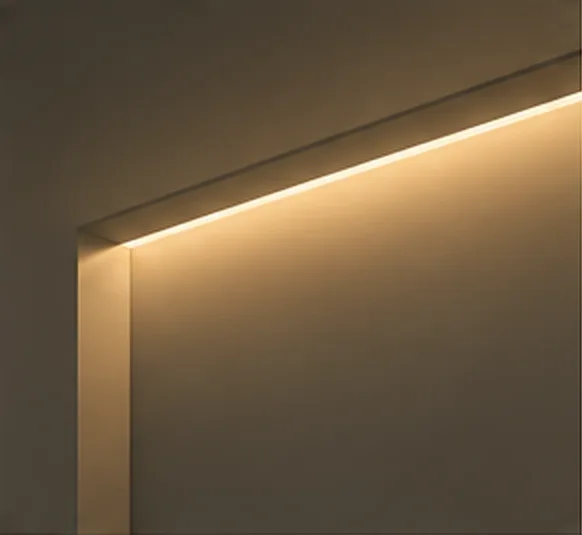
A beautiful plaster texture may need a particular light direction to reveal its subtle irregularities. A timber screen may benefit from separation between foreground and background. A curved ceiling can appear more expressive when a concealed luminous line follows its geometry.
The decision begins with the material and the intended shadow, not with the most fashionable profile or spotlight. When the optical effect is right, the fitting often becomes visually secondary.
Grazing and washing are not the same
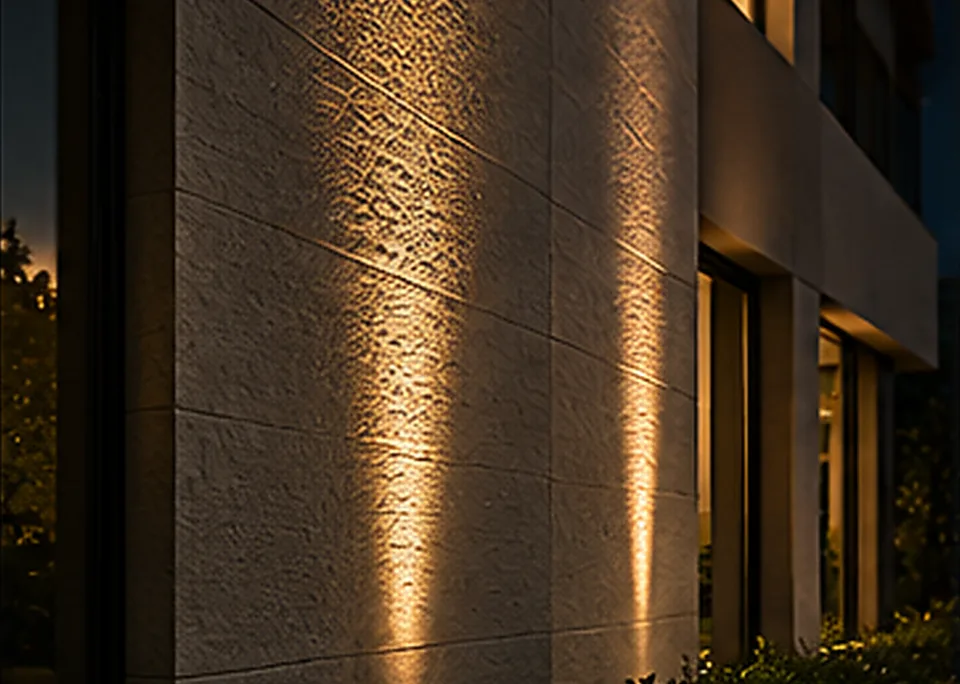
Wall grazing places light close enough to the surface to emphasise relief and texture. It can be striking on stone, brick or carefully finished plaster. It can also reveal every uneven patch, joint and defect in a surface that was never intended for that scrutiny.
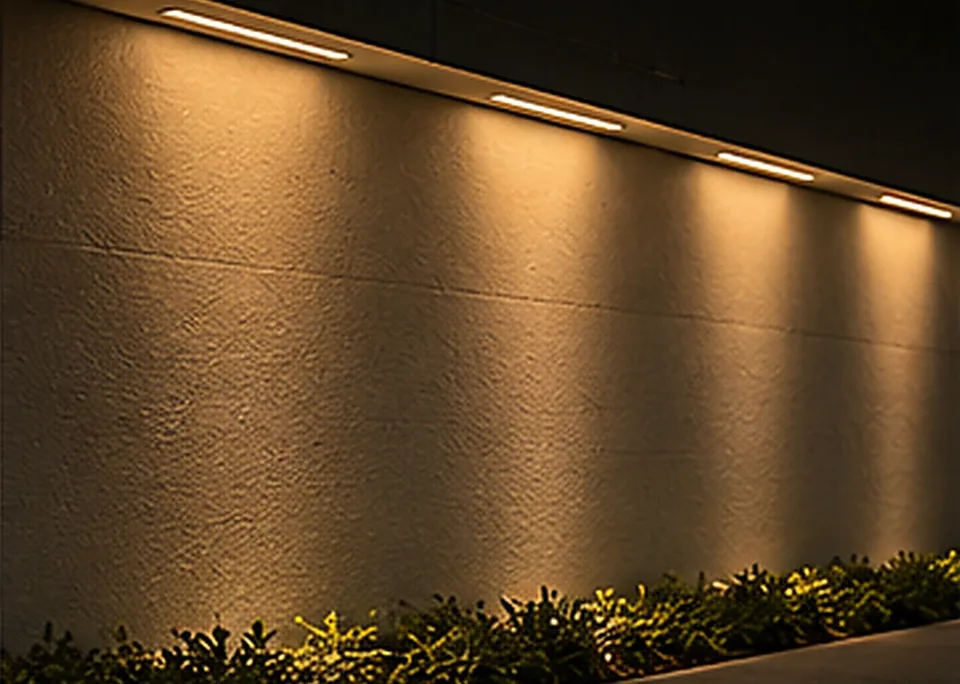
Wall washing seeks a more uniform illuminated plane and often feels calmer. Its success depends on the optics, spacing, setback, height and finish of the wall. A generic placement rule is a risky substitute for a real mock-up and photometric information.
The choice should follow the surface and the designer's intention: show texture boldly, or allow the wall to read as a continuous background.
Concealed light has construction consequences
A cove, recessed profile or hidden linear light only looks effortless when the edge detail is resolved. Where will the source sit? Can it be seen from the opposite side of the room? Is the diffuser visible as a bright stripe? Where can the driver be accessed? Will the plaster finish tolerate the chosen grazing direction?
The joinery and ceiling contractor need to understand the lighting effect as well as the channel dimensions. Small differences in recess depth or edge alignment can change the result dramatically.
Let shadows participate
Architectural lighting is not a contest to remove every shadow. If every plane is equally bright, texture and depth can disappear. A well-positioned accent can create a sense of volume by allowing surrounding areas to remain less prominent.
Of course, circulation and task surfaces still need appropriate visibility. Shadows should be intentional, not an excuse for inadequate functional lighting. This balance is where architecture, lighting and everyday use meet.
The problem with too many hidden lines
Continuous LED lighting is visually appealing, so it is easy to add it everywhere: around the ceiling, under every cabinet, across every shelf and along every wall. Eventually, the room may be dominated by luminous outlines rather than the architecture those outlines were meant to support.
Edit ruthlessly. Ask which lines reinforce a meaningful form and which are merely repeating a visual trick. A single concealed detail in the right position can be more persuasive than ten competing ones.
What a convincing mock-up reveals
A mock-up should show the actual material, real mounting position, intended diffuser or optic and an appropriate lighting condition. Stand where visitors will stand. Sit where occupants will sit. Look for reflected sources, unexpected hotspots, uneven washes and maintenance issues.
Photography is useful, but a phone camera can flatter or distort the result through automatic exposure. Judge the light in person where possible.
Restraint can be a measurable decision
If two linear details are doing the same visual job, consider whether one can be removed without diminishing the design. If a wall already has enough light to express its texture, more fittings may only flatten the effect or add glare.
Good editing is part of lighting design. The aim is not to demonstrate the number of technical possibilities available; it is to reveal the architecture clearly and comfortably.
The finest concealed lighting leaves a paradoxical impression: something has clearly been designed, yet nothing is shouting for credit. The architecture feels more articulate because the lighting has given it a voice without becoming the whole conversation.
Explore the lights: Architectural lighting
Have a lighting requirement? Ask us on WhatsApp.